Wednesday, October 7, 2009

SAITA presents Shellbark Hollow Farm, Cheese Making workshop and tour

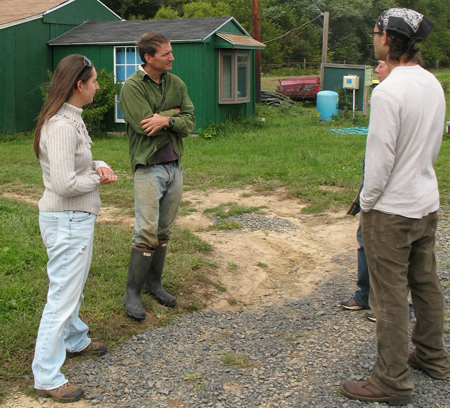
Our last workshop of the season was held Saturday, October 3rd at Pete Demchur's Shellbark Hollow Farmin East Goshen Township, where he raises Nubian goats and makes excellent cheeses. Managed with the help of his sister Donna Demchur Livitsky, who was involved with the Harvest Festival at Stargazer's Vineyard, their friend Maureen was helping Pete coordinate the day.

Pete has worked the farm for about 15 years, on just 3.6 acres, with another 2 acres across the street and a separate 1.5 plot and barn in the same block. With a total of 50 goats, 30 of them milkers, he doesn't need much land. He averages about 1 gallon of milk daily from each, yet suggests that most larger farms get 2-3 quarts from their goats. It's obvious that Pete's goats adore him. They're all happy, very vocal and as friendly as your pet Lab.  

Pete began the workshop with a little history about how he began cheesemaking. He spent five years perfecting his recipes before he sold one ounce. Rather than copy what other cheesemakers produced, Pete developed the signature tangy taste of his Sharp 2, his wonderful spreads and his creamy chevres for his own palate. Most of the time he doesn't even add salt. He depends on the quality of his milk to give him one of the best award winning products this side of the Atlantic. Even the French producers have commended him on his talents as a cheesemaker. Latest is a Tomme that he's perfecting. 

Because goat's milk has a smaller molecular structure than cow's milk, it is more easily digestible and more like human milk. The genetics of breed and quality of feed are important too. Pete mixes a custom grain, made up of flax and western alfalfa. His babies and bucks get local hay because they don't need much protein when young. The milkers get the special mix, up to 2 lbs per day. His milkers get as much food as they want; he keeps them fat and again- happy. Because goats are susceptible to the same diseases as cows, cleanliness is paramount.

He tries to breed early in the year during September, so a buck is put in with the 'girls' in June, in an effort to get babies before the fall. Separating them at birth reduces stress and disease on both the mother and baby, making future animal management easier as well. Pete has a monitor set up in the birthing room so that he can be ready when they are. His 3-4 mature bucks barely eat during rutting season and the dominant animal breeds the most. At between 3 and 5 days old, most bucks are sold at auction as either pets or for meat. Longevity for males is 7 years, for females it's a little longer at 9 to 10 years. 


Amazingly, goats will eat very brushy plants like poison ivy, thistle and multiflora. Azalea, rhododendron and hemlock are all poisonous to goats so be careful about which fields you put them in to graze. Pete suggests that if they have enough good food they won't go for the bad stuff. Goats have been used in the city of Los Angeles instead of landscape crews for cleaning steep hillsides. They're more environmentally sound than gas weed whackers, and they cost the city less! Read about it here.


Back to the cheese. Pete showed us how to pasteurize. Heat milk to 160 degrees, cool to 80 or 90 degrees, then add bacteria or your live culture. If you're doing a raw milk cheese, only heat to 80-90 degrees. For a sharp cheese, add enzymes before you add the rennet. There are different enzymes for different kinds of cheeses. Pete documents each batch to have a record of what went wrong, when anything rarely does. We sampled one cheese that had a pronounced moldy skin that was especially tasty. Mold is a naturally occurring  antibiotic.


There are several suppliers who will sell to small producers. New England Cheesemakers is one online store to buy your cultures, rennets and other supplies. Dairy Connection and Canada's Glengarry Cheesemakingoffer supplies for both home hobbyists and commercial producers. Pete buys untreated butter muslin for straining his milk from Rockland Industries and uses plastic baskets from garden nurseries as the containers.


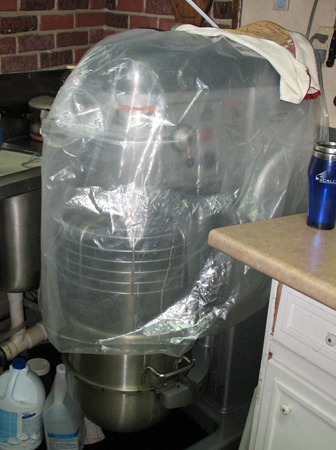
The cheese room is where Pete does all his cutting and processing, packaging, weighing and adding herbs. He uses a commercial Hobart mixer to whip their delicious spreads; Hot and Sweet Chevre was the variety I brought home... and promptly consumed half. It had a little spiciness from hot peppers, superbly blended with a trace of sweetness.

For yogurt he suggests letting it sit for 12 hrs as opposed to the shorter 8hrs for cow's milk. First he heats to 140 degrees, using a homemade bread warmer hooked up to a thermometer.


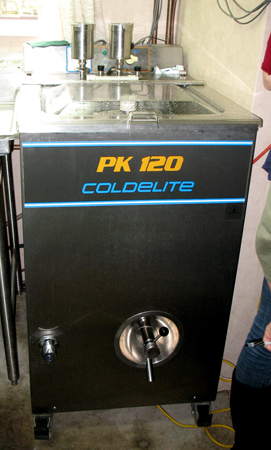
For his cheesemaking, he bought a special PA approved graph temperature meter that new, costs about $4,000. His pasteurizer, a PK120 Goldelite normally runs $22k and is designed for making ice cream. He got his on EBay for $3800. Unfortunately my searches for a link came up with nothing, I expect they're no longer made.  

We ran into similar legal issues at Shellbark Hollow that we saw at Pleasant Pastures with the Amish farmers trying to market their raw milk. Pete complained that the graph temp meter isn't as accurate as other less expensive versions, but that by PA law, he's bound to use only that model. All cheese laws are written for cows and don't take into consideration goats.

Pete says that knowing your animals is key, he says- 'you can't make good cheese out of bad milk'. And he spends most of his time milking and working with the goats. Sister Donna helps to develop recipes, manages sales and packages and ships for the farm. Seven part-time helpers round out the team and help with a weekly farmers market. Pete has found them on craigslist, PASA and through word of mouth.

The seven interns/farm apprentices, one youngster and I had a great time at Shellbark Hollow and I'd like to thank Donna, Pete and Maureen for coordinating and offering so much of their time. This workshop went way beyond our normal end, but was well worth the couple of extra hours that Pete generously donated. 

Make sure you stop by or hit the Phoenixville Farmers Market to get some of his incredible cheese. And don't forget to say hi to the goats!


Look for SAITA's workshops to begin again next spring.

Best wishes for a restful and healthy winter!
Victoria Webb
SAITA Coordinator
vic@furiousdreams.com

http://www.maysiesfarm.org/saita.html#calendar

Thursday, October 1, 2009

CSA Update

It's truly fall! The chestnuts are falling at a rapid rate. You will see them listed on the board as a Pick Your Own item. When you pick the chestnuts, you do need to take them home and roast them, boil them or freeze them for later use. If you leave them to sit out on your counters, you will become inundated with tiny little worms! Apparently there's a little wasp that lays eggs in the chestnut flowers in July and the nuts and prickly husk form around the eggs. In late September, the husks open and the nuts fall to the ground. If they sit there for an extended time, the eggs inside hatch and little white worms emerge to carry on the wasps' life cycle. Quite the science lesson, but not really what you want to witness on your kitchen counter!

If you choose to roast the chestnuts, simple take a sharp knife and cut an "X" in the flat side for the shell (to prevent them from exploding), then put them in the oven. You can also boil them in salted water for about 20 minutes. Then, you will need to peel them! A bit time consuming, but well worth the effort!! Search the internet at www.badgersett.com for chestnut recipes.


A classic recipe is chestnut stuffing for Thanksgiving. Yes, Thanksgiving is right around the corner and Ben is now offering his delicious pastured turkeys. Turkeys less than 15 pounds cost $3.80 per pound. Any turkey over 15 pounds costs $3.65 per pound. Turkeys will be delivered FRESH either Friday 11/20/09 or Monday 11/23/09. He will also have frozen turkeys in time for the Christmas season (but more about that later!). There will be a sign up sheet in the barn- please write your name, the weights you would prefer and the pick up day. You need to order the turkeys by November 9th.


Sunday October 4th, 6 pm Maysie's Farm Harvest Full Moon Pot Luck Dinner. This is our last get together of the season. Sunday is slated to be a beautiful day- join us for the potluck and bonfire under the full moon! Hope to see you there!


Welcome to our two new interns- Meghan Morris and Nate Ela. We're looking forward to having them here- please stop by to meet them when you pick up your food!


RECIPE:

Celery Root (or celeriac) is an edible root vegetable in the celery family. It may not look pretty, but is delicious when roasted, braised, put in soups or mashed. It can also be sliced very thinly and eaten raw.

Celery root needs to be peeled before cooking. The leaves are not very edible, as the plant puts most of its energy into producing the root. Celery root can be used in any recipe that calls for celery.

Below is a recipe for a celery root salad with apples and walnuts:

Celery Root and Apple Salad with Toasted Walnuts
serves 4 to 6

2 medium celery roots, peeled and cut into matchsticks
2 medium red delicious apples, cored and cut into matchsticks
2 tablespoons fresh lemon juice
3 green onions, thinly sliced
1 bunch watercress leaves
dressing:

2 tablespoons red wine vinegar
1 tablespoon mustard seed
1 tablespoon mustard
1 tablespoon honey
1/2 cup vegetable oil
salt and pepper
1 cup walnut halves, toasted

Combine the celery root and apple in a bowl and sprinkle with lemon juice. Toss with the green onion and watercress. Whisk the vinegar, mustard seed, mustard, honey and oil until well combined. Toss with the celery root mixture. Taste for salt and pepper and garnish with walnuts.


See you around the farm!

Annmarie and Sam


Think Globally, Eat Locally
Maysie's Farm Conservation Center
15 St. Andrew's Lane Glenmoore, PA 19343
(610)458-8129 www.maysiesfarm.org

Monday, September 28, 2009

SAITA presents Pennypack Farm, Community Started Agriculture

Fred Beddall, Farm Manager of Pennypack Farm in Horsham, PA, led a series of questions for the 7 interns and 3 speakers who attended this workshop on Saturday, September 26th. Speakers included Margot Bradley, Pennypack's Program Coordinator, Amy Johnson representing Red Hill Farm and John Fowler from Anchor Run Farm in Wrightstown Township.

Fred moderated the session, asking a series of questions that ranged from how the farms originated, to infrastructure and operations and how funding processes were developed. He also followed up with details about shares, which crops are grown and finally asked how the farms had each found 'good fortune' and evolved profits. Some of my video is challenged from the gusty winds that day, but you can turn up the volume to hear the audio.


Red Hill Farm CSA: Amy Johnson is the former Director of Farming Operations from Red Hill Farm in Aston, PA. The farm's  6 acres is in its 8th year of production, on a 183 acre tract owned by the Sisters of St. Francis. The Sisters generously bought everything, including two high tunnels, and other equipment required to run the farming operation. Luckily they already owned mowers, backhoes and bobcats with an auto shop and heated greenhouse with potting shed on the premises.

Amy was paid full-time with benefits as manager at Red Hill and they offered 3 interns $100/week with 3 meals a day. One of the interns received housing but the other two were local. The second year the Sisters hired her husband as a co-farmer and the CSA doubled. However, since the rules forbade women and men living together, this became a hardship for housing issues. The small trailer on the land wasn't large enough to support two adult men, and women interns didn't always show up in pairs. The solution was hiring local help at $10/hr - no benefits.
The CSA supported 100 people the second year and they offer 10 workshares. In exchange for 100 hours a season, the farm offers a share. Members are required to work 4 hours weekly.


Red Hill applied for a $40k grant to put solar panels on the barn, supplying energy to the well. They have a strong core group of 10 people who were there from the beginning, helping with fundraising, orientation and on pickup days. They work with their members to coordinate farm products, newsletters and office type jobs.
Red Hill has participated in potlucks and fundraisers to save for necessities like a walk-in cooler and composting toilet even though the Sisters cover most items. The farm supplies food for the 70 to 80 member convent and there is also a large retirement center on the property. Although children are welcome in a designated garden, the living situation for women and men is not ideal and families who want to work and live on the farm would find this a challenge.

Anchor Run CSA: John Fowler, a professional geologist and member of the Wrightstown Township EAC, was raised on a small farm and has been with Anchor Run Farm since they began. The space was purchased by the township through a planning grant with the support of 2500 residents and supervisors. The CSA was begun through a master plan developed through a grant given by the PA Dept of Conservation and Natural Resources (DCNR). The process to organic farming has been gradual, and John mentioned that most farmers in the area still rely on outdated methods; using Roundup and mono-cropping corn or soybeans. Anchor Run does have issues with drift from these treated fields that can compromise their organic beds.


The farmers on Anchor Run own all the mobile equipment like tractors and mowers, and the township, through a combination of financing assets, maintains the deer fences, greenhouse, existing barns and homestead. Anchor Run used grants from the state to drill a well and had an Energy Harvest grant for solar panels that power the well and cooler. Volunteer labor was used to help build the deer fencing, greenhouse and hoophouse. The township provides one house at a reduced rental rate for a farmer.
Two farmers live on site and pay rent to the township. They employ and pay out of their own pockets, the 3 interns at $10/hour - no benefits. The farmers make their income from 180 CSA shares, from 230 families. They have 75 families currently on their waiting list and offer a small discount off the $750/share fee to Wrightstown residents.

However, John admits that the last farm managers had two young children and were barely able to sustain themselves. With no affordable healthcare or retirement funding, they decided to move to Israel and work a Kibbutz where housing and healthcare costs are covered. Fortunately they knew how to operate and set up a farm before they arrived at Anchor Run, so that a system was in place after their departure, for subsequent farmers.

There is an active core group at Anchor Run, which helps to operate the CSA and website, scheduling and interaction with the farmers. They have benefited from highly supportive township supervisors, state grants and advertising on PASANOFA and other farm sites. The Bucks County Foodshed Alliance is a local entity that offers much support for the area. Check out Anchor Run's website for some great ideas. They offer a newsletter, recipes, events and links to other farmers markets in the area.

Pennypack Farm CSA: Pennypack is unique in that it's both a farm and a non-profit education center employing Andy Andrews as the full-time Farm Director, Fred as the full-time Farm Manager, both with full benefits, and Margot Bradley as the center's half-time Program Coordinator, along with 2 seasonal farm workers. Initially called farm interns, the second year workers are elevated to 'farmer' status. Mid-season intern Jessica Gerani was there to answer any questions about her own experience.


Margot Bradley was one of the original founders of the farm in 1999. Now coordinating projects, writing grants and developing new programs for the non-profit center, she talked about its origins. In March of 2003 the land was basically barren. By May they had a CSA up and running and hired a farm manager, offering full benefits. Two years ago the farm was able to support a second full-time farmer with benefits, and local interns were brought in to help during the season. There is no available housing and they have never had unpaid internships. The center has as its core value a 'living wage', even though in the past this has sometimes been beyond their reach. Over 30 workshare members bring in the harvest on about 8 acres and help with distribution. All members have workshare duty at 4 hours/share or can buy them out at $60.


From their website:
'Pennypack Farm grew from the commitment of a handful of citizens who responded to a letter in a local newspaper (Ambler Gazette, April 2000) suggesting the formation of a community farm for the purpose of accessing fresh, local, organic produce and preserving land within our watershed. Initial dialogues among these committed citizens grew into a vision and a plan for action. The organization gradually took shape over the next two years, finally culminating in early 2003 with the formation of an 11-member Board of Directors, the signing of a lease for land to grow crops, the hiring of a farm manager and assistant, and receiving official charter as a 501(c)(3) educational non-profit corporation.'


Starting with 90 shares, the CSA increased to 100 the second year, and the share model was changed to units in 2006. Pennypack offers units in two different sizes; a large share equals 10 units/week at $675, the smaller share is 6 units/week at $450. The unit is approximately a bunch or 1 lb, members are trained to weigh the produce and a limit for units is set on whatever is not abundant at the time. There are sign-in and out sheets for workshare members, a long-time volunteer board member usually overseeing these time management tasks.

This year they hired a professional bookkeeper and plan to increase the share prices in 2010. Margot says they also plan to expand to having 14 acres in production over the next few years.
In addition to the CSA, Pennypack offers a Local Foods Market in their pickup building, open to members 3 days a week from 2:30pm to 7:30pm. Margot proudly showed off the two new coolers she'd picked up from a liquidation company located in Princeton, NJ - and they even deliver!

In 2009 Pennypack's farming program will operationally break even, not including equipment purchases. $70k is raised yearly from individuals and grants to support capital improvements and educational programming. The goal is to have a 3 month operational pad. 

The education center offers a low income summer camp and partners with the College Settlement of Philadelphia, their land-lease host who who has owned the 253 acres since 1973. The community landowners are a non-profit with their own board, offering the farm a one year revolving lease. Wonderful educational signs identifying farming techniques and methods are situated in front of crops and various garden beds; secured through a grant, they explain to both children and adults the benefits of sustainable farming, like no-till, beneficial insects and crop rotation.


Margot suggests that the Local Foods Market at the farm will begin generating more profits as it becomes more well known. Greeters work the register and network with the local community. There is an outreach volunteer and they are expanding events and potlucks, adding activities like cooking demonstrations, and family campfire evenings. Giving the public an opportunity to participate and help is an effective way to build membership and visibility in the community.
The final agreement was that while all three farms are sustainable, none are yet making much of a profit.


With more public support-through pledges to buy from local producers- and with a variety of funding and creative efforts, farming has a very good chance of becoming profitable in urban communities. The state of Illinois just passed a bill making a commitment to restructure the food system to promote local consumption. Vermont launched a Keep Local Farms program this month and the Mayor of San Francisco pledged this July to create a Sustainable Food Mandate for the city, reputed to be one of the most ambitious food policies in the country. There is renewed hope for local farming!

We appreciated the different aspects and challenges of each farm startup and heartfelt thanks to Fred, Margot, Amy and John for sharing their individual goals and 'good fortunes' with us.

Stay tuned for the last SAITA presentation of the season on October 3rd, 11am to 1pm at Shellbark Hollow Farm. Topic will be a Cheesmaking workshop and farm tour, with special appearances by Maggie and others.

Happy fall and best wishes for a productive and healthy winter!
Victoria Webb
SAITA Coordinator
vic@furiousdreams.com

ps Happy Cat Organics will be offering a tomato seed saving workshop on October 9th at the Fermentation Festival in Kennett Square. Tim's workshop with us has been cancelled for this season.