
We had a large turn-out of about 16 interns, one farmer and one general public for this workshop on greenhouse/high tunnels and tomato production. Willow Creek Orchards is a family farm located in central Montgomery County, Worcester Township, Pennsylvania. Drew and Melissa Smith live and work on the farm with their daughters. They transitioned 138 acres of farmland over a three year period to become a USDA Certified Organic farm in 2004. They use ecologically sound practices, without synthetic chemicals.
On the 138 acres, Drew keeps about 38 in woodlands and grows straw and summer hay for his dad's cows, along with hairy vetch and rye for cover crops. He also grows sorghum-sudan grass and cowpeas for cattle feed. Some fields will be left fallow for 2-3 years to replenish the soil. However, he doesn't use rye as a cover crop for potatoes.
He has 14-15 acres of orchard, including 8 acres of apple trees, 4 acres of Asian pears, 3.5 acres of peaches, a few plums, a 5 acre blueberry field, 1.5 acres of fall raspberries, 1 acre of blackberries, and 3 acres of pumpkins, winter squash and gourds. He uses his two greenhouses and three 24' x48' high tunnel houses for tomatoes, vegetables and also plants 1/4 acre of garlic, along with an acre of lettuce. That's a lot of food.
He offers pick your own flowers and 1/2 acre of sunflowers as well. Like a few of the other farmers we've seen in these workshops, he doesn't do many farmers markets because of the labor and time involved, but he will take his strawberries and asparagus to Phoenixville this year. He has a couple of wholesalers who pick up from the farm. He and Melissa also have a lovely retail market on the premises, offering local meats, dairy, veggies, pastries, homemade pies and desserts and wonderfully aromatic soaps. They also market fruits and other products through their 'Pick-your-own' farm offerings.
Drew bought one of his 30' x 96' greenhouses from Griffin Greenhouses and for his High Tunnels he uses a roll-up side with the smooth side out so that water runs off it. You can get zipped end walls from FarmTek, and they also offer the full package greenhouse. He also mentioned Nolt's and Rimol's as suppliers.
He uses 128 cell trays for his tomatoes, filled with straight potting mix. He has begun using 'DotPots', which are certified organic biodegradable pots made in France. However, I would advise trying to find something that isn't using peat moss, as these do contain 20% peat and we know the bogs need to be protected, both for carbon sequestration and because disturbing them releases carbon into the atmosphere. Please avoid using peat moss at all if you can help it.

He uses heat mats for starting his tomatoes and suggests germinating them quickly or they may rot in cool weather. When they're quite small, he transplants them into larger pots. When hardening off the tomatoes, he advises withholding watering and lightly running a broom over the plants to stress them. For hardening off, he takes the plants outside in the morning, then they go back into the greenhouse later in the day.
He explained that dramatic changes in temperature can cause tomatoes to be leggy, so if the greenhouse is 90 degrees during the day and then drops to 40 at night, they need to be subjected to an even temperature or hardening off before selling as viable transplants. He plants all determinate varieties for his high tunnel tomatoes, on black pastic and woven fabric.
Drew advises pruning all suckers on the tomato plants except the top ones. Remember to wash your hands after picking off diseased suckers or leaves before going to the next plant. He also cuts off all the leaves beneath the 'cluster' which will give the plant more air flow, especially necessary in a greenhouse. He plants up to the top leaves, covering any hairy stem with soil. Each one of those hairs will produce roots.
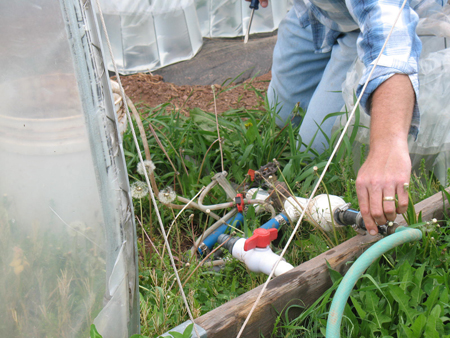
He uses Saylor's plastic water cloches or hot caps over his transplants in the high tunnel houses and fertilizes with a compost tea that runs through his drip irrigation via a fancy looking fertilizer injector with a backflow protector from Rain-Flo. He's planting in black plastic, but also suggests planting onions or lettuces between tomatoes instead.

He advises cutting the tops off the hot caps when the tomatoes are growing out of them. He also rigs up tomato twine with vine clips on the beams of the greenhouse ceiling, that the indeterminate plants can be trained to climb, then lowers the cord as the tomatoes fruit, to increase light inception and for ease of harvesting.
A big issue for greenhouses is mold and disease. Drew sanitizes according to organic regulations with a chlorine solution once or twice a year and cleans all surfaces. He does use test strips to test his dilution and urges doing this to keep your chlorine content low. It might be possible to use vinegar instead, but that needs more research. He also disinfects his larger plastic pots with the same solution.
Drew takes a leaf sample test 3 times during his season; when the plant is flowering, bearing fruit and later in the season. He sends these into Aggra analysis who will email results. Potassium is important for tomatoes and pumpkins, he uses Nutribalance PK. He uses calcium (Aragonite) to prevent blossom end rot. Calcium can't move up through the plant well, so he uses a foliar spray of Calcium 25 or Vigor-Cal/phosphate. His general fertilizer is a 4-2-4 from Fertrell. Aggrand kelp is a liquid fertilizer he uses when the plant flowers. He advises against brewing compost tea, since studies have found spikes in E-coli during this process. He uses a mesh bag for his compost tea, letting it sit in water just a few hours.
Drew rotates greens with tomatoes and prevents late and early blight, along with verticulum and bacterial wilt this way. His choices for tomatoes are indeterminate types such as Fabulous, Favorita, Red Grape and Sungold. Heirlooms that he likes are Brandywine, Brandy Boy, Green Zebra, Striped German. He notes that Valencia may be a better striped variety than Striped German, and doesn't tend to crack. Mortgage Lifter is an old variety that he and I are both trying out this season just for its lucky heritage.
Crop rotation and no-till production are two foundations of Willow Creek and Drew mentioned Steve Groff, the local guru of no-till. You can read about Groff's methods here.
Another tip Drew offered is from Steve Moore, called the 'Gandhi of Greenhouses'. Moore tested light refraction on the Gothic style versus a Quonset Hut. Results from his $200 solar greenhouse make me want to go out right now and buy a greenhouse package: The Gothic arch design gives better penetration of sunlight and ventilation than the usual half-round Quonset hut style greenhouse. It is oriented east-west instead of the usual north-south so that you get the maximum amount of solar gain with the largest amount of surface facing south, Moore explains. "The arch design is much stronger than Quonset-style greenhouses and also sheds snow and ice more readily."
Read more about Moore's innovative 'Super Greenhouses' here. Drew follows this advice, situating his greenhouses east to west, and plants his cold hardy vegetables along the cooler back walls. He buys bumblebees from Koppert Biological and each greenhouse gets a hive set in a back corner. He'll order these in January for a May 1 delivery when the tomatoes begin flowering. He will also put ladybugs in the greenhouses after removing covers for aphid control. For tomato hornworm or other caterpillars he uses Dipel Df (BT).
Drew grows some varieties of strawberries in black plastic and discussed their production. He also mentioned another expert in the field, Marvin Pritts at Cornell. Foliar spray will produce bigger strawberries, but not more of them. Research about timing indicates that spring may not be the best time to apply foliar sprays since plants aren't trying to absorb the most nutrients. If you spray in the fall, the plant will pull the nutrients into the roots.


